From Reactive IT to Operational Excellence
For many IT teams, a reactive workday can become the new normal. A system goes down, a user loses access to an application, a security alert needs investigation, or an executive needs an issue resolved immediately. By mid-morning, the work that was supposed to matter that day has already been replaced by whatever demanded attention first.
Some amount of that is unavoidable. Technology fails, users need support, and unexpected problems will always happen. The real issue is what happens when reacting becomes the dominant operating model. When teams spend most of their time responding to incidents, there is less capacity to address the conditions that could have been preventable to begin with
That is where operational maturity begins to matter. The goal is not to create an IT environment where nothing ever goes wrong. It is to build one where problems are identified earlier, recurring issues are reduced, routine work is handled consistently, and the team has enough capacity left to improve the environment instead of simply maintaining it.
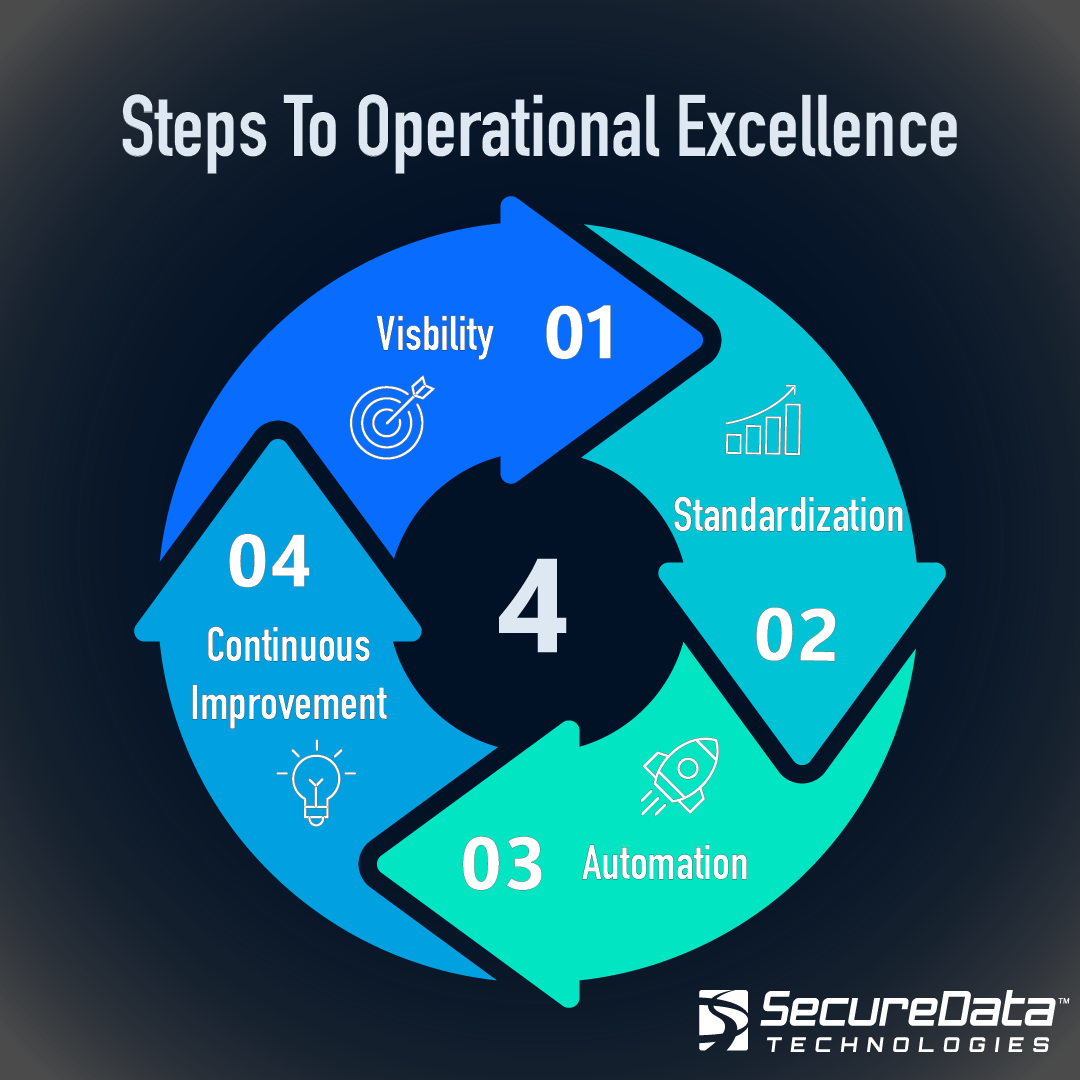
Better Visibility Creates Better Decisions
Reactive IT often starts with a user noticing a problem before the technology team does. By the time the issue is visible to the business, IT is responding under pressure.
Improving visibility changes that dynamic. Monitoring infrastructure, networks, cloud environments, endpoints, backups, and security systems gives teams a better chance to identify warning signs before they become larger disruptions. That does not mean every problem can be predicted, and it does not mean more monitoring is automatically better. Poorly configured tools can create more noise than useful information.
The value comes from having enough reliable visibility to understand what is happening in the environment and act on it before the business experiences the consequences. In that sense, monitoring is not about collecting more alerts. It is about reducing surprises and giving the IT team more time to make deliberate decisions.
Operational Knowledge Should Belong to the Organization
Most IT teams have at least one person who knows where the bodies are buried. They know the strange configuration nobody documented, remember why a particular system behaves differently, and know which workaround actually works. That expertise is valuable, but it becomes a risk when the organization depends on one person being available whenever something goes wrong.
Standardization and documentation are often treated as administrative work, but they are part of what makes an IT environment sustainable. When configurations are consistent, procedures are documented, ownership is clear, and escalation paths are understood, teams are less dependent on memory and improvisation.
This does not mean every process needs to be rigid or every exception eliminated. Some environments genuinely require complexity. The goal is simply to make sure that complexity is intentional rather than accidental. If a recurring issue can only be resolved because one engineer remembers what happened three years ago, the organization has knowledge, but it does not yet have a reliable process.
That difference becomes more important as teams grow or shrink, responsibilities change, and experienced employees move into new roles or leave the organization. Individual expertise should strengthen operations, not become a single point of failure.
Automation Works Best After the Process Makes Sense
IT departments are full of repetitive tasks that seem small in isolation but consume a surprising amount of time when added together. Password resets, software deployments, device provisioning, patching, user onboarding, backup verification, and ticket routing are all necessary work, but not all of them require a person to make a meaningful decision every time they occur.
Those are natural areas to consider automation, but automation is not useful simply because a task can be automated. A poorly understood process does not become better when software performs it faster; it can simply allow inefficiency, errors, or unnecessary complexity to operate at a larger scale. For the business, that can mean higher costs, greater operational risk, a worse employee or customer experience, and more expensive corrections later. Understanding and improving the process first helps ensure that automation removes friction rather than quietly multiplying it.
The better approach is to first understand the work well enough to know which parts are repetitive, predictable, and stable. Once that foundation exists, automation can remove unnecessary manual effort and allow technical staff to spend more time on work that requires judgment.
That reclaimed capacity is one of the more practical benefits of operational maturity. If routine work consumes less of the team’s time, that time can be redirected toward security improvements, infrastructure modernization, data initiatives, technical debt, or other projects that are difficult to prioritize when the day is dominated by support work.
Activity Metrics Do Not Always Show Improvement
IT teams naturally track activity. Ticket volumes, response times, closure rates, and similar measures are useful because they help leaders understand workload and service demand. The problem comes when activity is mistaken for performance.
Closing 1,284 tickets in a month may indicate an efficient support organization. It may also indicate that employees experienced the same preventable issue 1,284 times. Without additional context, the number cannot tell leadership whether the environment became more reliable.
Operationally mature organizations still pay attention to activity, but they also look at what changes over time. Are recurring incidents declining? Is service availability improving? Are outages shorter when they happen? Are users experiencing fewer disruptions? Is the organization becoming better prepared to recover from a failure?
Those questions connect IT operations to business outcomes rather than simply measuring how much work the team completed. Ticket volume still matters, but it becomes more useful when it is considered alongside the conditions creating those tickets.
A strong operational report should help leadership understand whether technology is becoming easier to manage, more reliable, and less disruptive to the people who depend on it.
Improvement Has to Be Part of the Work
One of the challenges with operational improvement is that it rarely arrives as a single project with a clear end date. Technology environments change constantly. New systems are introduced, old ones remain in place longer than expected, business needs shift, security threats evolve, and temporary workarounds have a tendency to become permanent.
That makes continuous improvement less of a transformation initiative and more of a habit. Teams need opportunities to look beyond the immediate problem and ask why it happened, whether it is likely to happen again, and whether the current response is still the best one.
Sometimes that leads to a large modernization project. More often, the improvement is smaller: documenting a procedure, changing an alert threshold, removing an unnecessary manual step, standardizing a configuration, or fixing an issue that has quietly become accepted as normal.
Those small improvements matter because they compound. Fewer recurring incidents mean less interruption. Less interruption creates more available time. More available time makes it possible to address larger problems that would otherwise remain buried beneath daily support work.
Operational excellence is not really a destination. It is the gradual result of making those improvements consistently enough that the environment becomes easier to operate over time.
Where AI Fits
AI can support this progression, particularly in environments where large amounts of operational data are already being collected. AI-enabled tools can help identify unusual patterns, correlate events across systems, summarize information, and recommend possible responses. As those capabilities improve, some organizations may be able to move from simply reacting to known problems toward predicting and, in certain cases, automatically responding to them.
The important distinction is that AI does not replace the operational foundation underneath it.
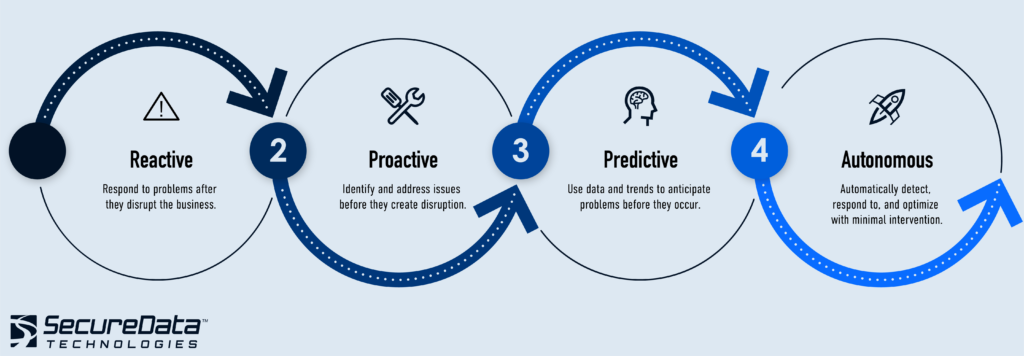
If an organization has limited visibility, inconsistent processes, unreliable data, or poorly understood systems, adding AI does not make those problems disappear. It may simply produce faster analysis of an environment the organization still does not understand particularly well.
AI is more useful when it builds on mature operational practices. Reliable data, clear processes, sensible automation, and good governance give those tools something meaningful to work with. In that context, AI can extend existing capabilities rather than serving as a substitute for them.
A More Useful Question About IT Maturity
Organizations can measure operational maturity in many ways, but one simple question can reveal quite a bit:
How much of the IT team’s capacity is spent maintaining the business, and how much is spent improving it?
There is no ideal percentage that applies to every organization, and maintenance work will always be necessary. The question is useful because it exposes the balance.
If nearly all available time is consumed by outages, recurring incidents, troubleshooting, and repetitive manual work, the team may be functioning well under pressure while still struggling to move the environment forward. If more capacity becomes available for modernization, security improvements, automation, and other planned initiatives, that usually suggests the underlying operation is becoming more stable.
The point is not to eliminate reactive work. It is to make sure reactive work does not consume so much attention that improvement becomes impossible. A mature IT organization still solves problems when they occur. It also learns from them, reduces the number that recur, and creates enough room to make the next problem less likely than the last.
Ready to become more proactive than reactive? Schedule a consultation with us today!