The AI Readiness Gap: Why Most Organizations Aren’t Ready for AI Yet
And Why Technology Isn’t the Real Challenge
Artificial Intelligence has quickly become the most discussed topic in boardrooms, executive meetings, and strategic planning sessions across nearly every industry.
From predictive analytics and intelligent automation to generative AI and machine learning, organizations are racing to identify opportunities to improve productivity, reduce costs, and gain competitive advantage.
Unfortunately, many organizations are asking the wrong question. Instead of asking, “How do we implement AI?” they should first ask, “Are we ready for AI?”
The reality is that most organizations don’t have an AI problem. They have a readiness problem.
This challenge mirrors many of the issues discussed in our article on The Alignment Problem: Why IT and the Business Still Aren’t on the Same Page, where we explored how leadership alignment often determines whether technology initiatives succeed or fail.
In our experience working with small and mid-market organizations, AI often exposes weaknesses that already exist within their business:
- Inconsistent data
- Lack of governance
- Security vulnerabilities
- Siloed systems
- Undefined business processes
- Misaligned executive priorities
AI simply shines a brighter light on these challenges.
What Is AI Readiness?
AI readiness is an organization’s ability to effectively deploy, manage, secure, and scale artificial intelligence technologies. It requires a strong foundation of trusted data, governance, cybersecurity, modern infrastructure, and executive alignment to ensure AI initiatives deliver measurable business outcomes.
Why do AI Projects Fail?
Many organizations assume AI is a technology initiative. It isn’t. AI is a business transformation initiative.
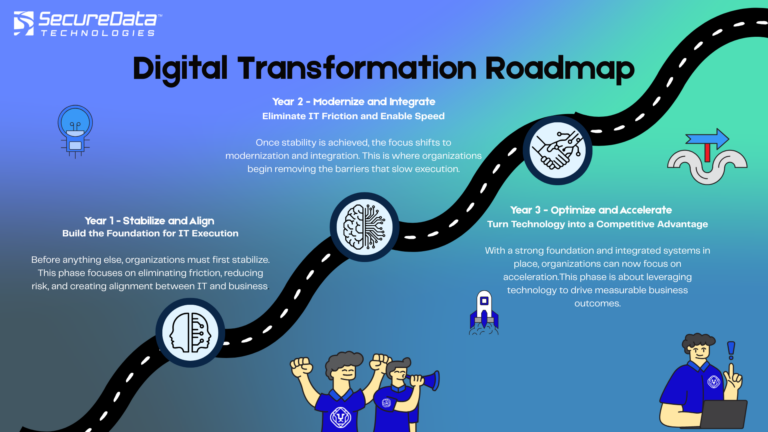
In fact, organizations pursuing AI without a broader technology strategy often encounter the same obstacles outlined in our Digital Transformation Roadmap, where successful transformation begins with business objectives rather than technology purchases.
Organizations that approach AI as a software purchase often struggle to achieve meaningful outcomes because the foundational elements necessary for success were never established.
Technology alone cannot compensate for poor data quality, unclear ownership, or ineffective processes.
Before AI can deliver value, organizations must ensure they have a solid digital foundation.
The Four Pillars of AI Readiness
Organizations that successfully adopt AI typically have four foundational elements in place:
- Trusted and accessible data
- Strong governance and accountability
- Comprehensive cybersecurity controls
- Modern, scalable infrastructure
Without these pillars, AI initiatives often fail to deliver measurable business value.
The Executive Leadership Challenge
The biggest barrier to AI success is rarely technology. It is leadership alignment.
Successful AI initiatives require collaboration between C-suite executives to department leaders. When executives pursue AI for different reasons, projects frequently stall before delivering measurable value.
Organizations that begin with clear business objectives consistently outperform those that begin with technology.
How can organizations prepare for AI adoption?
Organizations can prepare for AI adoption by assessing their readiness across four key areas: data, governance, security, and infrastructure. Leaders should identify specific business outcomes they hope to achieve, evaluate data quality and accessibility, establish governance policies, strengthen cybersecurity controls, and ensure their technology infrastructure can support AI workloads. A structured readiness assessment helps organizations build a strong foundation before investing in AI solutions.
Final Thoughts
Organizations seeking to assess their readiness for AI should begin by evaluating their data, infrastructure, cybersecurity posture, and technology strategy. Through our Infrastructure Transformation, Strategic Advisory, and Microsoft AI consulting services, Secure Data Technologies helps organizations build the foundation necessary for successful AI adoption.