The Digital Transformation Roadmap for Mid-Market Businesses: A Practical 3-Year Blueprint
Every organization today is talking about digital transformation.
New platforms. Cloud migrations. Data initiatives. AI pilots. The plans are ambitious and the investments are significant. Yet, most organizations never fully realize the outcomes they expect. This is where a digital transformation roadmap sets the course.
What is a digital transformation roadmap?
A digital transformation roadmap is a strategic plan that outlines how an organization uses technology to improve operations, align with business goals, and drive measurable outcomes over time.
Digital transformation doesn’t fail because of vision. It fails because of execution.
For mid-market companies especially, the challenge isn’t knowing what to do, it’s knowing what to do first, what to do next, and how to actually make progress without overwhelming the business. This is where most roadmaps fall apart.
Many organizations approach digital transformation like a checklist:
- Move to the cloud
- Improve cybersecurity
- Implement new systems
- Explore AI
While all of these may be valid initiatives, they often lack:
- Clear sequencing
- Defined priorities
- Organizational alignment
- Governance and accountability
The result?
Too many initiatives launched at once. Too little progress on what matters most. And ultimately, limited business impact.
A roadmap that tries to do everything ends up accomplishing very little.
What a Digital Transformation Roadmap Should Actually Do
A successful roadmap is not a list of technologies.
It is a structured path from current state to business outcomes.
It answers three critical questions:
- Where are we today?
- Where do we need to go?
- How do we get there—step by step?
For successful mid-market organizations, the most effective roadmaps follow a phased, outcome-driven approach over 24–36 months.
The 3-Year Digital Transformation Blueprint
This blueprint is designed to help organizations move from fragmented IT environments to fully aligned, high-performing technology ecosystems.
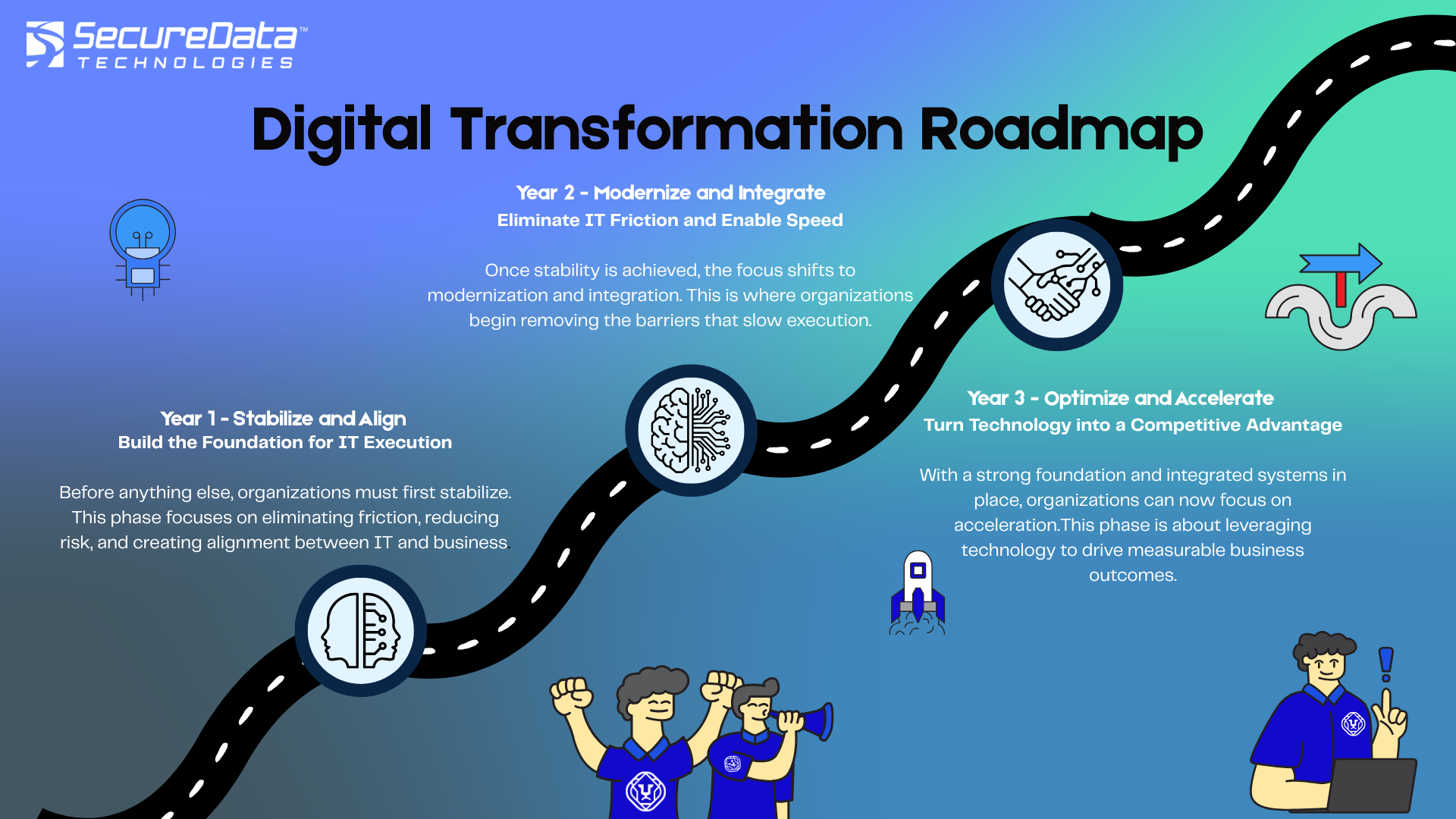
Year 1: Stabilize and Align
Build the Foundation for IT Execution
Before anything else, organizations must first stabilize. This phase focuses on eliminating friction, reducing risk, and creating alignment between IT and business.
Key Priorities:
- Assess Current State
- Infrastructure, security, and application landscape
- Operational maturity and gaps
- Business alignment challenges
- Define Business-Aligned IT Strategy
- Tie technology initiatives directly to business goals
- Establish clear success metrics
- Cybersecurity vulnerabilities
- Backup and disaster recovery gaps
- Compliance exposure
- Standardize Core Operations
- Improve visibility and monitoring
- Establish consistent processes and documentation
In year 1 the goal is to build greater stability, reduce operational noise, and develop clear direction for future investments. Without this foundation, transformation efforts will struggle to gain traction.
Year 2: Modernize and Integrate
Eliminate IT Friction and Enable Speed
Once stability is achieved, the focus shifts to modernization and integration. This is where organizations begin removing the barriers that slow execution.
Key Priorities:
- Network and system upgrades
- Integrate Core Systems
- Break down silos between applications
- Improve data flow and accessibility
- Move toward integrated, layered cybersecurity
- Implement identity and access management strategies
- Optimize User Experience
- Improve collaboration tools
- Enable remote and hybrid workforce capabilities
In year 2 the goals are to drive faster execution of initiatives, improve decision-making through better data access, and escalate organizational agility. At this stage, technology begins to shift from a constraint to an enabler.
Year 3: Optimize and Accelerate
Turn Technology into a Competitive Advantage
With a strong foundation and integrated systems in place, organizations can now focus on acceleration. This phase is about leveraging technology to drive measurable business outcomes.
Key Priorities:
- Advanced Data & Analytics
- Turn data into actionable insights
- Support real-time decision-making
- Identify high-impact use cases
- Improve efficiency and scalability
- Continuous Optimization
- Refine systems and processes based on performance
- Drive ongoing improvements
- Align ongoing investments with evolving business goals
- Provide executive-level visibility into performance
In year 3 the goals manifest into increased revenue opportunities, improved operational efficiency, and develop stronger competitive positioning. At this stage, technology becomes a true business accelerator.
The Critical Role of Sequencing
One of the most common mistakes organizations make is trying to jump straight to Year 3.
They pursue AI, advanced analytics, or new platforms without first addressing foundational issues.
This leads to:
- Underperforming investments
- Frustrated teams
- Limited ROI
Sequencing matters.
You cannot accelerate what isn’t stable. You cannot optimize what isn’t integrated.
The 3 Most Common Digital Transformation Mistakes
Even with a clear roadmap in place, many organizations struggle to gain traction. Not because the strategy is wrong, but because execution breaks down in predictable ways.
Here are the three most common mistakes that prevent digital transformation from delivering real business outcomes:
1. Trying to Do Too Much at Once
One of the biggest pitfalls is launching too many initiatives simultaneously.
Organizations attempt to modernize infrastructure, implement new systems, strengthen cybersecurity, and explore AI…all at the same time.
The result?
- Competing priorities
- Resource strain
- Slowed progress across the board
The most successful organizations sequence initiatives intentionally and execute them in phases.
2. Skipping the Foundation
Many organizations try to accelerate before they stabilize.
They jump into advanced capabilities like AI, automation, or analytics without first addressing core infrastructure, security, and integration challenges.
This often leads to:
- Underperforming investments
- Poor data quality
- Limited ROI
You cannot accelerate what isn’t stable. You cannot optimize what isn’t integrated.
3. Lack of Governance and Accountability
Even the best roadmap will fail without clear ownership and structure.
When initiatives lack defined accountability, consistent tracking, and executive alignment, progress quickly stalls.
Common symptoms include:
- Missed timelines
- Shifting priorities
- Lack of measurable outcomes
Execution requires discipline. Governance is what turns strategy into sustained progress.
Most digital transformation challenges are not unique, they are the result of these common, avoidable mistakes.
Organizations that recognize and address them early are far more likely to:
- Maintain momentum
- Maximize ROI
- Achieve meaningful business outcomes
The Missing Piece in Most IT Roadmaps: Governance
Even well-designed roadmaps can fail without proper governance.
Transformation requires:
- Clear ownership and accountability
- Defined milestones and metrics
- Regular executive alignment
- Ongoing prioritization
Without governance, initiatives lose focus and momentum. With governance, transformation becomes structured and measurable.
What Success Looks Like
Organizations that follow a structured, phased roadmap begin to see meaningful results:
- Technology investments aligned with business outcomes
- Faster execution of strategic initiatives
- Reduced risk and improved resilience
- Stronger collaboration between IT and business leadership
Most importantly, they move from reactive IT environments to proactive, high-performing organizations.
Driving Results
A digital transformation roadmap is only valuable if it drives execution and if execution drives results. The organizations that succeed are not the ones with the most ambitious plans. They are the ones with the clearest path forward—and the discipline to follow it.
Secure Data Technologies helps mid-market businesses build and execute transformation roadmaps that are grounded in reality, aligned to your business goals, and designed to deliver measurable outcomes.
If you’re ready to move beyond planning and start making real progress, it starts with a roadmap tailored to your business objectives.
Let’s identify what’s holding your IT transformation back and map your path forward.
Frequently Asked Questions
1. What is a digital transformation roadmap?
A digital transformation roadmap is a strategic plan that outlines how an organization will use technology to improve operations, drive growth, and achieve business objectives over time. It defines priorities, timelines, and key initiatives needed to move from the current state to a more advanced, digitally enabled organization.
2. How long does digital transformation take for mid-market companies?
For most mid-market organizations, digital transformation is a 2–3 year journey. The first year focuses on stabilization and alignment, the second on modernization and integration, and the third on optimization and acceleration. The exact timeline depends on the organization’s current technology maturity and business goals.
3. Why do most digital transformation initiatives fail?
Most digital transformation initiatives fail due to poor execution rather than poor strategy. Common reasons include lack of prioritization, disconnected systems, weak governance, and misalignment between IT and business leadership. Without a structured roadmap and clear accountability, even well-funded initiatives struggle to deliver results.